skip to main |
skip to sidebar
This weekend was the Khmer Pchum Ben holiday, and Em & I decided to visit Ho Chi Minh City in Vietnam. It was our first visit to Vietnam, and living in Phnom Penh, the level of development and environment in Ho Chi Minh were striking - there were trees and parks everywhere, the roads were good, there were pavements to walk on, no-one drove on the wrong side of the street and very few ran red lights. Crossing the road was a joy...it's surprising how simple things can bring such pleasure.
Although we only explored the centre, I really found Ho Chi Minh to be a wonderful city. The people we met were friendly, it was easy to get around, and I loved the architecture, bars and restaurants. We had been given some great recommendations for places to eat and drink - the stand out for me was "The Refinery" (74/7 Hai Ba Trung St), a French bistro which served the best steak i've eaten in South-East Asia. I thoroughly enjoyed my birthday, which included a visit to the fascinating "Reunification Palace" and a micro-brewery tour organised by Em (more on both of these later).
Anyway, below is a random collection of photo's, and a video showing a traditional Vietnamese musical performance on the steps of the opera house, watched by large numbers of moto riders who were cruising past and stopped to check it out.


Day one of my walking adventure began at 6am in a small flat in Notting Hill. Our friend Josie had been kind enough to put us up the night before Em headed back to Phnom Penh. My whirlwind descent from frenetic London to sleepy Suffolk began with a train-ride and an emotional farewell at Heathrow. Then I was flying up the M11 in my hire car bound for Suffolk. The early start and bad traffic wasn't really getting me in the mood for a leisurely saunter, and I found myself stressing out about small things, getting lost trying to map read whilst driving, and finally sitting in a stationary traffic jam of holiday makers somewhere on the A14. It was hot and sunny, and I could just imagine the bored kids in the family saloon in front giving their parents a hard time. I finally made it to Bury St.Edmunds, and after a short spell lost again on the country lanes of Suffolk, rolled into the small market town of Diss. It was much later than i'd hoped, 1pm in fact, which added to my stress levels as i'd hoped to get a full day's walking in. I quickly located a quiet street to park the car on, and packed the few items of equipment I had into the day pack. It felt quite strange, but also exciting, to walk away from the car down the road without any clear idea of where I was going or where I was staying.
A quick pit stop in town to buy a snickers bar,  fill up with water, and check where the Angles Way started at the tourist info office and I was away. Diss very quickly faded behind me and I was straight into Constable country, I almost expected to walk around a bend in the river to find the artist and his easel on the river bank. The countryside here was flat and pastoral with pockets of woodland and occasional church spires from distant villages, cows roamed grazing and the tiny River Waveney lazily snaked through the open shallow valley. The path mainly followed the river, diverting occasionally to cross bridges over frantic dual carriage-ways, and pass through small villages. My own rhythms gradually slowed during the afternoon as I came down from the forced high of modern life and adapted to the slow, steady pace walking along the river bank. I started to enjoy what was around me; dragonflies, butterflies, hares standing alert to see who the intruder was before bolting into the hedge, a flock of crows, startling some pheasants out of the undergrowth, eating a blackberry off the bush (it was really a bit early and the berry was very tart).
This part of Suffolk is beautiful and was exactly what i'd come in search of, despite the long distance footpath it doesn't seem to be particularly popular with tourists which added to the charm for me. I only saw a few people all afternoon; an old bloke out for an afternoon stroll down the lane and a farmer overseeing the early harvest of his wheat who were both very friendly. Near Brockdish I was surprised to hear the sounds of jazz from across the fields. It was a wedding in a field next to Brockdish church, with a marquee and a live jazz band, and it looked like they were having a great time. Later, I was chased by an old half-blind sheepdog on a farm, and walked past a wonderful deciduous woodland running along a ridge.
As the afternoon wore on, my thoughts turned  to food and accommodation. This became a recurring theme, around mid-afternoon each day I would start looking ahead on the map to spot likely villages which might have a pub, and woods or heathland which might be suitable for a surreptitious bivouac. It was already 7pm due to my late start, but the wonderful late English summers evening meant I had light until 10pm. I had high hopes for Mendham, I was tired as I descended through fields down to the river and bridge. There was a pub, hurrah, but unfortunately they didn't serve food, and even worse there was no real ale! So, I had to drag my reluctant body onto the next village. After getting lost again, and scaring myself in some woods at twilight (I was certain someone was behind me but when I looked there wasn't, you know the one), I finally staggered into Homersfield at
  dusk, hoping beyond hope that there was a pub, otherwise it was snickers bar and water for dinner. Homersfield came up trumps with the Black Swan. After a pint of Adnams I asked the landlord if there was anywhere to camp close by and he offered the field behind the pub for a few quid. As it was so late, and due to my exhaustion I gladly accepted, particularly as it meant I could have dinner (sausage & mash) and a few more cheeky pints before turning in. It had been a big day, starting in Notting Hill and ending up at the Black Swan, Homersfield. I'd walked 17.5 miles by my reckoning which wasn't a bad effort and probably reflected my rat race mentality early on. I resolved to take things much easier the next day.
Em & I hosted our first proper dinner party last week. We invited everyone in Em's team at work, so there were five of us all told, and I knocked up a few Asian dishes which seemed to go down pretty well. Two of Em's colleagues are Khmer, they both speak excellent English and it made for a really fun and interesting night. I thought a couple of random snippets of conversation were worthy of a post, so here they are...
Firstly, we've finally understood why tuk tuk & moto drivers are never able to locate our street when we ask for street 55. Phnom Penh is laid out on a numbered grid system, with the East-West streets getting even numbers (ascending from North to South) and the North-South streets getting odd numbers (ascending from the river Westwards). The French planners even had the foresight to start the Northern most "even" streets at 60 to allow for the inevitable expansion. This makes navigating around Phnom Penh really easy (although house numbering is very haphazard but that's another story). Anyway, it turns out that locals don't bother with street numbers and mostly don't know what they are. They prefer to use either the street name (a small number of streets have both a name and a number), or navigation by landmarks / places. It seems bizarre to use this method when there is a ready made numbering system but there you go.
Secondly, a bit more IT stuff. Whilst I was working, I realised that most of the computers had two languages installed - English & Khmer Unicode. Khmer uses a sanskrit based alphabet with (I think) 33 discrete characters. I didn't pay much attention though, as the keyboards were standard English QWERTY without any overlay's or dual language labelling. According to Em's work colleagues, they do produce Khmer language documents on their PC's, and when they need to do so they just use memory, or trial and error, to find the right keys. How hard must this be ? I really have a new found respect for them, working predominantly in English (their second language) and typing blind when producing anything in Khmer. A bit of internet research reveals that there are groups out there working on native Khmer keyboards (and dual language overlay's), but it doesn't appear as though these are widespread at all. Further to this, the massive explosion in mobile phones and texting has meant that a lot of young Khmer's in Phnom Penh are communicating primarily in English when texting - most phones don't support Khmer language natively. I can't help thinking that embracing a foreign language so readily in these new forms of communication may not be a good thing in the long term for nurturing Khmer language.
Anyway, the dinner party was a great success and we've resolved to try to do more entertaining.
I've been crook for the last week with some nasty virus. I'm better now, just in time for our visit to Ho Chi Minh City, but unfortunately I was laid up for the whole weekend of our friend Pia's visit (although I think Pia & Em had a great time judging by their hangovers on Sunday).
So, a funny thing happened when I went to the doctor (sounds like the start of a joke doesn't it ?). It was day three of feeling not so great, I was laid up in bed and suddenly deteriorated into alternate cold sweats and hot feverish periods. As an aside, fevers in the tropics are really tricky. You have to regulate your temperature here at the best of times with ceiling fans and aircon, but when your internal thermostat is loopy it makes it extra hard to work out what to do. Anyway, after some much needed nagging from Em (I get a bit surly when i'm sick) I decided to go to our local health clinic. I remembered just before leaving the house that Cambodian's are big on the hygienic face mask. This is really a very civilised habit which I think we should adopt - if you're sick or have a cold, and you need to go where other people are, you put on one of those surgical face masks to prevent coughing and breathing on people. You see people at the office wearing them all day if they're feeling under the weather.
The health clinic is just a couple of streets away, but I really could hardly walk. With Em's help, I made it into the waiting room. It was pretty quiet, just a receptionist and a few nurses sitting on the chairs - I guess they were waiting for patients. So, I fill in a form and get asked to wait. I turn around. The waiting room has maybe 20 chairs in 2 rows. There are four nurses dotted around in that kind of annoying pattern where you can't sit anywhere that isn't close to someone. So, Em & I sit down next to these two female nurses. They've obviously been eyeing up my half bent over weak demeanour, sweaty face, bloodshot eyes and mask, and decide it's time to go. They both get up straight away, walk over to the other side of the waiting room and sit down again. Then they both look at me and laugh (through their masks). And I laugh back (through my mask). It really cheered me up.
This kind of directness and sense of humour are pretty typical of the Khmer, and it's really refreshing. As it turns out, i've just had some virus which has cleared up apart from a headache (although i'm putting this down to coffee withdrawal symptoms from the treacle we drink here). Apparently I also have an amoeba which I have to take anti-biotics for, but that's pretty common.
During my recent visit back to England I found I had some spare time in the hectic visiting schedule, four days in fact, in between catching up with my family in Dover and visiting my brother in Lancashire. Emma would be heading back to Phnom Penh, and my friends would all be at work. So what to do myself ?
After a two year absence from my mother country i'd been fantasising about England. Living in dusty, tropical Phnom Penh i'd often find myself listening to the "Enigma Variations" by Elgar and day-dreaming of ancient oak trees, rolling green fields and balmy summer evenings. I hadn't any time to prepare (which is very unlike me), and I didn't have any equipment to speak of, but the idea occurred to me to go for a walk in the countryside.
Hastily researched over the course of at least two hours using my families bookshelf I settled on a walk in Suffolk. My key influences were; Roger Deakin - one of my favourite authors of the moment who lived in Suffolk and wrote very passionately about the nature thereabouts, the "Good Beer Guide 2009" which lists a great many wonderful country pubs and breweries in Suffolk, and a book on my sisters bookshelf on Constable. If the countryside here had inspired such a great painter, surely it would also fulfill my yearning for green fields and open skies. During my youth, i'd hiked, climbed and cycled all over the British Isles but for some reason had never visited Suffolk. I suppose it's flatness hadn't appealed to the climber in me as a young man, so that was one more reason to go. Finally, my complete lack of equipment would surely not be a problem in the flat lands of the fens - I might be uncomfortable, but at least I wouldn't become a mountain-rescue statistic lectured in the local paper about my lack of preparation and equipment.
So, I had my destination. Now for equipment, a small daypack, light walking shoes, waterproof, torch, water bottle, 1 season sleeping bag (borrowed), 1 man bivvy tent (purchased hastily in London before dropping Emma at Heathrow), map of Suffolk (1:50,000), notebook. The whole would fit nicely in my small day pack, allow me to be totally independent and not give me a back-ache by the end of the day. I resolved to bivouac out as much as possible, partly to save money, but mainly to try to engage as much with nature as I could. In short, I would be really walking, not like the overloaded scout hikes of my youth carrying everything including the kitchen sink. Of course there was a price to pay in comfort but more on that later.
I would take along a copy of "Walking" by Henry David Thoreau, a short pamphlet in which Thoreau proposes that we have all forgotten how to truly walk, or "saunter" as he puts it. Thoreau offers up two derivations of the word "saunter" in the first pages of the book. The first, which he prefers, relates to the Crusades. I, however, was struck by the second definition and it influenced my planning of the walk.
"...having no particular home, but equally at home everywhere. For this is the secret of successful sauntering. He who sits still in the house all the time may be the greatest vagrant of all; but the saunterer, in the good sense, is no more vagrant than the meandering river, which is all the while sedulously seeking the shortest course to the sea..."
So, I would go sauntering in Suffolk, carrying nothing but the essentials in my small pack, with no place to stay and no planned route. I decided to start my walk in Diss, at the beginning of the "Angles Way" long distance footpath, and follow the River Waveney to the sea. After that I would see...
Stay tuned for the first episode of the walk, which takes me from Diss to Homersfield, and although it seems out of keeping with the philosophy behind my adventure, i've also produced a google map for the nerds out there (and me).
View Suffolk Sauntering in a larger map
Nerd alert...for anyone who isn't remotely interested in computers, read no further.
So, i've been doing some work over the last few weeks which has given me my first experience with IT in Cambodian organisations. Of course, much here is the same as anywhere else in the world, but there are a few trends which have genuinely surprised me.
Firstly, software licensing is a flexible concept. In all forms of media in South-East Asia, piracy is rife, and software is no different. I was a little surprised to discover that even commercial companies, government, IT companies and the like all run pirated operating systems and software but in truth it would be incredibly difficult to do the right thing here if you wanted to. Microsoft don't have a local reseller in Cambodia and to be honest there's no market for them to do so unless the legal environment changed. Short of buying a new PC with an OEM license, everything else can be considered cracked (even when installed by a legitimate IT service provider), and this does cause problems with updates eg: black-listing from anti-virus vendors etc. Although it would seem as though the lower levels of investment available would lend themselves to the use of open source software, the opposite seems to be true. The most widely available and most easily supported systems are all Microsoft.
Secondly, many companies here, including IT service providers, don't seem to understand the importance of applying current service packs and critical security updates (or of keeping anti-virus software current). Windows PC's and servers are often multiple service packs behind current, have automatic updates turned off, windows firewall turned off and no or poorly configured anti-virus software. If you've ever wondered where in the world all those zombie PC's are, I suspect South-East Asia hosts a very high proportion.
Thirdly, computer hardware is incredibly expensive here. A basic spec Dell laptop which sells online in the US for $500 USD, would cost $1000 USD from some vendors in Phnom Penh. They can't be purchased online, but even considering the middle men this is a big markup. I honestly don't know whether this is down to import duty, reseller or both.
Finally, and this one really was a surprise to me, Cambodia is in the throws of a 3G revolution. The fixed line infrastructure here (like most infrastructure in Cambodia) is lacking and requires significant investment, so ADSL services are very expensive and offer low speeds comparative to services offered even in Australia for example. However, the mobile market is booming and attracting significant investment. With a very young population providing ideal market conditions, Cambodia is effectively leap-frogging fast fixed line internet access and moving straight to mobile data over 3G. The mobile market in Phnom Penh particularly is very crowded, with multiple ISP's (or should that be telco's ?) now offering fast HSDPA 3G data packages, both for computer (via USB modem) but even more so for 3G mobile devices. Even mobile Edge services offer better value and performance than fixed line DSL currently. In such a booming market, with limited regulation i've no idea how the telco's are planning to control bandwidth usage and provide QOS. QB in particular has not placed any restrictions on it's HSDPA 3G data service (ie: Skype, VOIP are all functional), and they offer an unlimited data HSDPA package for $88 USD per month. I think this model is down to the high level of competition, and a "build it and they will come" mentality, although it remains to be seen if it will pay off. Anyway, with all this competition, the Cambodian consumer will only benefit as far as I can see.
I was surprised to read this article in the Phnom Penh Post this week, apparently the number of lightning deaths in Cambodia for the first 6 months of the year is already over 100 (more than the total for the whole of last year). There's no doubt there are some impressive storms here in the rainy season, and the country is very flat with few trees which I guess makes people particularly vulnerable, but I was still horrified that so many people each year are killed by lightning. To put it in perspective, this compares to a rate of 5-10 people killed per year in Australia (with a population of approximately 21 million), and 5 killed per year in the UK (with a population of almost 60 million). With Cambodia's population at only 14 million, this is an incredibly high figure.
http://www.phnompenhpost.com/index.php/2009063026802/National-news/lightning-deaths-in-2009-so-far-surpass-total-for-all-of-last-year.html
 I always thought there were just two types of bike valves - Presta and Schrader. The other day I needed to pump up the tyres on my Cambodian single speed mean machine, and I decided to pick up a pump instead of using the street corner repair guys. Anyway, a quick look at the valves on my bike left me a bit confused. I'd never seen anything like these before. Our guard, Vuthy, saw me looking perplexed and came over to help with his foot pump. Watching him I really couldn't understand how the valve worked. So, a bit of internet research later and i'd established they're called the "Woods" or "Dunlop" valve. Supposedly they were very popular in England back in the day (John Boyd Dunlop invented them and the pneumatic tyre which were fitted to J.K. Starley's chain-driven safety bicycle in 1888 - basically the first modern bicycle). Woods valves are apparently still the dominant valve in Japan, the Netherlands, Germany, and most of the developing world.
So, armed with this information off I went to the stationary shop (which  I knew from previous experience sells a lot more than stationary) and I buy a pump which at least has an adapter that looks similar to Vuthy's. They're very simple valves - the whole core can be removed and replaced - and rely on a rubber sleeve over the core to make the seal, and a locking nut to keep it in place. It's hard to get much pressure into them because of this. In theory, you can just attach the pump and inflate (there's a tiny hole in the core which forces air through but the rubber sleeve prevents it escaping). In practise I found it a little easier to release the locking nut a little bit to get the air in.
I think other expats here must get confused by these too because  every time I go down to pump up my tyres, Vuthy runs over to give me a hand.
http://en.wikipedia.org/wiki/Dunlop_valve#Dunlop_.28or_Woods.29
http://www.sheldonbrown.com/gloss_w.html#woods
http://www.sheldonbrown.com/gloss_dr-z.html#dunlop
Our friends Chris & Claire have been staying with us for a few days on their way to Vietnam and home to Melbourne in a few weeks. It's been really great having them. Last night we went out to the local park to check out some of the communal dancing that happens every night, I think for both fitness and fun. It's really popular here. The park is full of different sound rigs playing all kinds of music from traditional to dance competing for decibels, it's a real cacophony of noise. Some of the sets only attract a few dancers, or consist of a few friends performing a rehearsed routine, while others attract hundreds of people in line dancing style rows. Here's a couple of video's...in the first you can see Chris, Claire & Em tearing up the dance floor. I think Claire wins the dance off although the dance leader probably wouldn't approve of her individual break out moves. The second one shows the guys with the sound rig and the leader of the whole thing who wears a radio mic and calls the moves. I can't really imagine this taking off in our culture, we're too self conscious and just don't have this kind of group mentality, but the people here love it.
I really got into all things English on this trip home, including food - greasy breakfasts with black pudding, fish and soggy chips with mushy peas, Devonshire cream teas - i've no idea why people think the English can't cook. This particular experience, however, was a real challenge to my nostalgic reverie. We found a seafood shack on Deal beach and I ordered (clockwise from left in the picture below) jellied eels, whelks and cockles. Not brave enough to sample them on the beach where I might spit them out on some poor unsuspecting pensioner, I took them home which was probably a good thing. The cockles were great with salt and vinegar, definitely recommended (even my young niece and nephew liked these). The whelks were, well, meaty and took quite a bit of chewing. I don't think whelks are for me. The jellied eels, an East London speciality, hmmm...I love eels but the jelly didn't go down well with me at all...there's a before and after shot below.


Well, i'm back in Phnom Penh, and back online so expect quite a few posts over the next few days (they'll mostly be about England and our trip which was brilliant). I've also refreshed the site design, let me know if you have any problems with it.
Em & I are flying out of the Penh tomorrow bound for England. We'll be spending time in Dorset & Cornwall where our good friends Brad & Kristen are getting married, visiting friends in Devon, and spending time with my family in Kent & Lancashire. I'll also be staying on a bit longer than Em and i'm hoping to explore Suffolk, for no better reason than i've never been there. I'm really looking forward to going back this time, it's been two years since my last trip and I can't wait to catch up with everyone - especially my young neice & nephew. I've been an expat for over six years now, and the longer I stay away, the more romantic and misty eyed I get when I think about my homeland...you know...country pubs, red phone boxes, rolling green countryside etc. I'm sure this is a common expat complaint, and one quickly cured by the inevitable rain, traffic jams, townies and bad coffee when we arrive. Deep down I think we will still be able to find and enjoy a small slice of little England though, it really is a special place. I've bought the 2009 Good Beer Guide so at the very least we will be able to find a decent pint wherever we end up. Mmmm...warm flat English Bitter...
One of the domestic challenges of life in the tropics is ants. These tiny red buggers get everywhere, literally. It's not uncommon to find them crawling up your arm while watching TV, over the computer keyboard whilst you're typing, or floating in your cup of tea or glass of water. They're very small (about 1mm long) and pretty harmless but constant vigilance is required unless you want to wake up in the morning to find a column of thousands of ants coming in the front door, marching across the floor and into the kitchen bin in pursuit of some tasty morsel.
As domestic leader, it's my responsibility to take the fight to them. Unfortunately, ultimate victory is really out of my grasp - it's more like trench warfare. Every day the ants advance (over the top lads), I try to remove any potential food sources (especially by emptying the kitchen bin), sweep them all up and we start over again. I dread to think how many i've killed, it's lucky I don't believe in Karma. Mostly, we've gotten used to living with them now, just occasionally it really gets to me, like when I bought a nice french stick for our drinks party, left it on the table, and came back to it 30 minutes later to find it swarming with a hundred of the little blighters. Grrr...
Em's work colleague who lived in the Pacific was telling us that he used to put the kitchen table legs in 4 bowls of water and keep all the food on the table. It seems easier to keep everything in the fridge though, regardless of whether it needs to be refrigerated or not, and this is what most people here do. The three or four squished ants on the refrigerator seal are a testament to their determination...quick lads, now, it's open...
Em & I continue to explore the local eating establishments, and this week we found a right cracker. Tipped off by a fellow Phnom Penh blogger, we went to check out Mt Everest Indian & Nepalese curry house which is just across Sihanouk Boulevard from us. We've been to a few curry houses here and always passed this one by, it's pretty incongrous looking nestled in between an upmarket clothes shop and a Starbucks rip-off. So, I was pretty suprised to find that the food is cheap and delicious, the service is great and the decor (like all decent curry houses) includes a fish tank. OK, so the lager comes in cans and not pints, but the spicy Chicken Jenjaloo is definitely the best Ruby Murray i've had since leaving Melbourne.
I've been keeping up my training schedule pretty well the last few weeks, running 10km's around the local park a couple of times a week. Training here is really pretty hard - I run at 5pm in the evening, but it's still 30 degrees and 70% humidity. When I get back i'm literally soaked with sweat, and it's desperately hard to cool down. Even with the aircon cranked and standing under a cold shower, your body continues to pump out heat like a radiator. Anyway, the theory is that training in this heat should mean i'm super fit when the cool season (and the race !) come along in December. I've been managing 10km in a pretty consistent 46mins - when I was 18 I used to do 40mins (in a cold climate) so it's not too bad as I haven't run seriously for years. I just need to keep up the running, and up the distance to 15km over the next few months and I should be good for the race round the temples.
On a tenuously related note, I was out buying a yoga mat from Emma this morning. She'd had a tip-off from a work colleague that the local stationary shop sold them upstairs. This is the way so much shopping works here...expats swapping tips and secret locations as it's so hard to find many things and they usually aren't where you'd expect. Anyway, I was very surprised in between the yoga mats and table-tennis bats to find nunchuk's for sale. They really looked like they'd do some damage.
Last night I took Emma out to celebrate her birthday. The plan was to hit up a few places we hadn't been to before, and it was a suprise except she always found out the next venue before we arrived as I had to explain to the tuk tuk driver where to go.
We started at the Elephant Bar at Raffles Hotel, a taste of colonial hedonism. Beer aside, the drinks list here is incredibly comprehensive, so we started the evening with a Harvey Wallbanger, Manhattan, Long Island Iced Tea, and a Femme Fatale (a champagne cocktail which Jaquie Kennedy apparently ordered in 1967 on her visit to Cambodia). The service, drinks and decor really are great at this place, and it's good value in happy hour. Next stop, probably the best Italian Restaurant in the Penh - Le Duo on street 228 - which is just around the corner from us. I've no idea why we haven't been here before, we had some wonderful starters, a fine home made pasta and a good steak (for Cambodia) all washed down with a nice bottle of Chianti. The service was great, although the decor is a little crazy with a fake "Juliet's balcony" stuck on the wall. By this point we were both feeling sloshed and full, so it was kind of lucky that our last stop turned out to be closed - Swenson's ice cream. Oh well, we can check it out another time.
I'm feeling pretty sorry for myself this morning with a shocking hangover, although Em seems fine. Anyway, Em had a great night which is the main thing.
http://www.raffles.com/EN_RA/Property/RLR/Restaurants_Bars/Elephant_Bar.htm
http://www.phnom-penh.biz/cambodia-guide/phnom-penh/Restaurant/le-duo-restaurant-pizzeria
So, Emma had a flat tyre at lunchtime yesterday. She asked me to fix it and took my bike back to work (they're identical except hers is burgundy and mine is British Racing Green for extra speed). From experience I knew that this is exactly the kind of simple errand that can turn into a mission in a strange country where you can't speak the language. By the way, our Khmer lessons are going really well but we haven't covered words such as puncture, fix, wait why are you sawing the valve out of the inner tube with a hacksaw blade yet...but I get ahead of myself.
You might be thinking why don't you just fix the puncture yourself ? Very good question, my dad taught me to fix punctures along with a whole heap of other useful handyman skills when I was a kid, but it's just not the way it's done around here. Khmer's don't carry tools because you can find a mobile repair shop on every street corner where a few locals eke out a living fixing up bikes, scooters, motorbikes and tuk-tuks with a portable compressed air tank, puncture repair kit, bucket of water and the essential hammer. The bikes here are very basic, so it works well with this kind of system. I'm sure if you rocked up with some fancy western racing bike or suspended mountain bike with Shimano group-set it would cause quite a stir but pretty quickly they would work out what needed to be done (although they might use a hammer to do it).
So I point to my flat rear tyre and frown. Seems to do the trick on the communication front. My man sticks some air in, puts a blob of saliva on the valve and watches. Fiddles a bit, repeats the exercise. Seems to come to the conclusion that the valve is duff (i'm not so sure but hey, what do I know). So, surely i'll be getting a new inner tube right ? Oh no, my inner tube looks pristine compared to most of the tubes in service on bikes here which consist more of patches than rubber, and they're not going to throw it away for the sake of a valve. So, out comes the hack-saw blade. Starting to get a little bit sceptical but hey i'll go with it. He saws off the valve (at the rubber). I now have an inner tube with a gaping hole in it. All my western mechanical instincts are screaming at me to say something, but I wait with baited breath to see what happens next. Out comes a modified valve with a hand-made stopper of thick rubber...goes in the hole, glue on the tube around the new valve. OK, still not sure about this... Next, a hole is punched in a regular repair patch with a hammer (yay, the hammer). Patch goes on around valve. Hmmm, i'm trying to work out how they are going to stop the air leaking. Ah I see, a nut goes over the whole lot and gets cranked tight. Then it's back into the tyre, retaining nut over the top, air goes in and jobs a good'un.
These kind of methods apply to cars & motorbikes too. The back street mechanics workshops look like something from the Industrial Revolution in Britain. There isn't a car or bike in Cambodia which has ever had a manufacturers service (which makes buying a vehicle here a bit hazardous). The concept of manufacturers parts or even the right part for the job doesn't  really exist. The Russian Market which is popular with tourists, has around a quarter of it's stalls devoted to second hand scooter parts. If you were savvy enough you could go shopping for parts and build a scooter from the ground up. I was thinking the other day, if you took a random sample of say 100 people from the streets of London or Melbourne and let them loose in the Russian Market, how many could make a functioning vehicle ? I reckon you'd be lucky to get 2. Our knowledge and service economy, niche job specialisms and lives spent sitting in front of computers in glass towers have made us forget how to get by. It reminds me of the Golgafrincham storyline in The Hitchhikers Guide to the Galaxy. In Cambodia, my guess is 20 or maybe more could put together a scooter in the space of a day. These guys have mad skills, born of necessity and experience I guess. Not in a "Western, well trained, follow the manual, do everything right kind of way" but in a "get it back on the road using anything to hand, ingenious, it doesn't count if you don't use a hammer kind of way".
Oh, and the puncture repair is holding up well so far...
I've been thinking about registering for a road race around Angkor in December, so I decided to up the kilometres on my run this evening from 5km to 10km. I haven't run 10km in many years and all I can say is owww. It was a particularly hot night tonight and I was soaked with sweat by the end with a tomato head which everyone was laughing at on the way home. Also, a dog I walked past was scared of me at first but it got all fighty when it realised I was friendly and started chasing me down the road...should have used the old fake rock in the hand throw trick. Anyway, I managed 10km no worries so I think that means i'll have to register for the half marathon around the temples. Gulp...i'll be hitting you all up for sponsorship later as it's for charity.
Flying into Phnom Penh yesterday, we had an excellent view of the work going on to fill in Boeng Kak Lake as the plane circled to land. Those who have visited Phnom Penh will probably recognise this as one of the most popular backpacker haunts, the water front bars and guest houses offering sunset views over the water as thirsty backpackers enjoy a beer. I didn't have my camera with me unfortunately, but from what I saw the lake looks to be already roughly half filled with a huge tongue of sand protruding into it from the Southern shoreline. Boeng Kak Lake is being completely filled in and developed for commercial and residential purposes by Shukaku Inc and Yunnan - a Chinese company. The google map below makes it pretty clear how profitable this will be, the lake is just outside the CBD and once filled will be prime real estate.

The director of Shukaku is a CPP Senator (Cambodia's ruling party), and the development is expected to lead to the forced eviction of around 4000 families. The papers here run stories weekly which throw up questions about the development - compensation for the evicted residents, the impact on drainage in the area, the transparency (or lack of it) in the business dealings between Shukaku and the government, and the obstruction of public meetings held by the residents to name just a few. Regardless of the veracity of any of these reports, and putting aside the clear economic incentive for the work, the displacement of so many people seems to be inherently wrong in my opinion.
Em & I were in Bangkok at the weekend, visiting our good friends Pia & Sebi. It's the first time we've left Cambodia since we arrived 3 months ago, and we had a fantastic time hanging out. We spent a lot of time at the mall - shopping, going to the cinema, and eating great Japanese food. It was also Sebi's birthday and we went out to a pool-side roof-top party overlooking Bangkok's high rise skyline which was top fun. The whole experience really highlighted how first world everything is in Bangkok, and how small and undeveloped Phnom Penh is in contrast. Personally, i'm not a big fan of malls which I find incredibly soulless places and to me represent the pinnacle of our consumer culture (if you want to see them in a new light check out "Dawn of the Dead" - George Romero's 1978 zombie classic). Coincidentally, I had to go to one of Phnom Penh's few malls yesterday - Sorya mall was opened in 2002 and caused quite a stir because it was the first building in Cambodia with escalators (apparently the sight of adult Khmer's scared to get onto the escalator was quite funny), suffice to say it's not a patch on Bangkok's monster malls. Although it was a nice change to get a dose of modernity, and lovely to see our friends, I have to say it's nice to be back in small, dusty, friendly Phnom Penh.
Last night, we went to Meta-House to watch Kampuchea : Death and Rebirth - a documentary made in early 1979, just after Phnom Penh fell to the invading Vietnamese forces. The East German filmmakers Walter Heynowski and Gerhard Scheumann were some of the first foreign journalists to get access to the country after the Khmer Rouge fell from power. The film has an overtly political agenda but was both powerful and informative. The extensive interviews with Khmer Rouge mouthpiece Ieng Thirith are quite hard to swallow, despite the filmmakers intentions to discredit her (Ieng Thirith is one of the five senior Khmer Rouge officials currently in detention and awaiting trial at the ECCC tribunal in Phnom Penh). However, the interviews with the few inhabitants of a decimated city and their incredibly raw emotional accounts of the events of the last four years are compelling. One group of university students had just returned to their college. Intellectuals were one of the groups particularly targeted by the Khmer Rouge and this group of around 100 students had collectively lost more than 800 family members - for most of them their entire family. It's clear that as some of the few educated people left in the country, they would be particularly responsible for reconstruction. Also striking from the footage was how developed Phnom Penh was prior to the 1970's - it has been described as the pearl of South-East Asia - the level of sophistication in education, healthcare and infrastructure was all suprising to me, all of which was destroyed by the Khmer Rouge.
Most of all though, and the reason I would thoroughly recommend this documentary if you ever get a chance to watch it, are the incredible images of an empty city. In 1975, the Khmer Rouge literally emptied Phom Penh and marched all the residents out to rural communes (read labour camps) in an attempt to create their agrarian utopia. Imagine a city evacuated in a single day and left deserted for four years. The filmmakers got access to the city just after it was taken by the Vietnamese, and the footage is unbelievable. Everything deserted, the signs of a hurried departure but also undisturbed houses full of possessions, and nature taking the streets back. The Vietnamese had to work quickly to restore essential services such as water and electricity before the city could be repopulated. Engineers are shown at the city power station and water plant trying to get systems back online. I think the eeriest scene in the film was the footage of ceiling fans and air conditioners in houses across the city coming back to life when the power was restored after their owners left them on four years earlier.
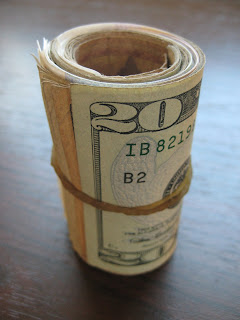
One of the things we've normalised living in Cambodia, but seems strange to a first time visitor is the monetary system. Daily life here never calls for a card of any sort - our credit cards & debit cards are at the back of a drawer somewhere. In fact, apart from posh hotels and high end stores, you couldn't use a card in Phnom Penh if you tried. Only one thing cuts it here - cold, hard cash. In fact, my wallet is so empty that i'm thinking of taking to carrying around a roll of notes like an East-End Gangster. The only complication in an otherwise very simple system is that there are 2 currencies in circulation here - US dollars and Cambodian Riels - and both are notes only (no coins). Cambodia opted to dollarize it's economy back in the early 1990's, presumably for the perceived stability of the currency. $1 USD is currently worth around 4200 riels. You can pay for things with either Dollars or Riels but in practise we usually pay in dollars, get large change in Dollars and small change in Riels. This works pretty well as it's always good to have a supply of Riels for sub $1 items such as food, drinks and moto's. Having said that, the 100 Riel notes can get pretty annoying, worth about 2 cents and not good for much at all !
I'm finding it increasingly hard to read the newspaper in Cambodia. It's not that I need a shaggy dog story, but it would be nice to read something other than cover to cover tales of government corruption and the downtrodden masses. A couple of stories really got to me recently, particularly as I encounter tuk tuk drivers on a daily basis.
Tuk tuk drivers are everywhere in Phnom Penh. We're in low season for tourists at the moment which means these guys are struggling for business and you frequently get propositioned by multiple drivers within the space of 100 metres walking down the street. I left our apartment yesterday to find 6 tuk tuks parked up in the street outside - it makes you feel guilty for walking or cycling. Anyway, your average tuk tuk chariot costs around $500 to buy outright, and we've recently discovered that a lot of drivers can't afford it so drive for a company. Back in the golden days of early 2008 a tuk tuk driver was earning $10 a day on average for 5 hires (a pretty good wage by Cambodian standards). However, the global economic crisis has been taking it's toll on the informal sector of the economy here, largely due to job losses in the formal sector, reduced investment, and lower tourist numbers. The net result is that the average daily earnings for a tuk tuk driver in early 2009 were just $4 for 2 hires. That's a 60% reduction and i'm sure makes it hard for a lot of these guys to pay the rent and support their families. I saw a couple of moto drivers coming to blows over a fare outside the supermarket yesterday and it's kind of understandable when your entire income for the day might consist of 2 rides.
But the economic crisis is affecting everyone, right ? For sure, but what really got me riled up was the Daun Penh local government's preparations for the ASEAN-EU meeting last week. We live in Khan Daun Penh, and it's also the home to most of the foreign embassies and some of the government buildings. In preparation for the meeting, the local government decided to do a street sweep to clean up homeless people, street vendors and tuk tuk drivers who were deemed to be 'unsightly' for the visiting dignitaries. I think the idea is misplaced as tuk tuk drivers add a lot of colour and life to the streets, as well as providing an essential service used by locals and tourists alike. In total, 34 tuk tuks were confiscated by the municipal government ahead of the summit. Drivers were allowed to reclaim them after the summit concluded, but as usual many were required to pay a "fee" to recover them. One driver reported he had to pay $55 to get his tuk tuk back, add in the loss of a few days wages and this is a big deal.
Worse still, in order to retrieve their tuk tuks the drivers were forced to sign an agreement which banned them from operating on 3 of Phnom Penh's main streets - Sisowath Quay, Norodom & Sothearos Boulevards. For those in Melbourne this would be like forbidding taxi drivers to use Collins St, Elizabeth St & Lonsdale St and effectively makes it impossible to ply your trade. When asked why the drivers were banned from these streets, Him Yan (Phnom Penh Deputy Municipal Police Chief) said "We do not allow tuk-tuk drivers to drive on some prohibited roads in the Daun Penh district" and offered no explanation for the ban.
Stories of corruption and high handed dealings like this are so frequent here, that it often seems that neither institutions or government have any interest at all in serving the people but rather their own self interest.
http://www.phnompenhpost.com/index.php/2009052926167/Business/Informal-sector-suffering.html
http://www.phnompenhpost.com/index.php/2009060926357/National-news/Tuk-tuk-ban-angers-drivers.html


 fill up with water, and check where the Angles Way started at the tourist info office and I was away. Diss very quickly faded behind me and I was straight into Constable country, I almost expected to walk around a bend in the river to find the artist and his easel on the river bank. The countryside here was flat and pastoral with pockets of woodland and occasional church spires from distant villages, cows roamed grazing and the tiny River Waveney lazily snaked through the open shallow valley. The path mainly followed the river, diverting occasionally to cross bridges over frantic dual carriage-ways, and pass through small villages. My own rhythms gradually slowed during the afternoon as I came down from the forced high of modern life and adapted to the slow, steady pace walking along the river bank. I started to enjoy what was around me; dragonflies, butterflies, hares standing alert to see who the intruder was before bolting into the hedge, a flock of crows, startling some pheasants out of the undergrowth, eating a blackberry off the bush (it was really a bit early and the berry was very tart).
 out for an afternoon stroll down the lane and a farmer overseeing the early harvest of his wheat who were both very friendly. Near Brockdish I was surprised to hear the sounds of jazz from across the fields. It was a wedding in a field next to Brockdish church, with a marquee and a live jazz band, and it looked like they were having a great time. Later, I was chased by an old half-blind sheepdog on a farm, and walked past a wonderful deciduous woodland running along a ridge.
 to food and accommodation. This became a recurring theme, around mid-afternoon each day I would start looking ahead on the map to spot likely villages which might have a pub, and woods or heathland which might be suitable for a surreptitious bivouac. It was already 7pm due to my late start, but the wonderful late English summers evening meant I had light until 10pm. I had high hopes for Mendham, I was tired as I descended through fields down to the river and bridge. There was a pub, hurrah, but unfortunately they didn't serve food, and even worse there was no real ale! So, I had to drag my reluctant body onto the next village. After getting lost again, and scaring myself in some woods at twilight (I was certain someone was behind me but when I looked there wasn't, you know the one), I finally staggered into Homersfield at
  dusk, hoping beyond hope that there was a pub, otherwise it was snickers bar and water for dinner. Homersfield came up trumps with the Black Swan. After a pint of Adnams I asked the landlord if there was anywhere to camp close by and he offered the field behind the pub for a few quid. As it was so late, and due to my exhaustion I gladly accepted, particularly as it meant I could have dinner (sausage & mash) and a few more cheeky pints before turning in. It had been a big day, starting in Notting Hill and ending up at the Black Swan, Homersfield. I'd walked 17.5 miles by my reckoning which wasn't a bad effort and probably reflected my rat race mentality early on. I resolved to take things much easier the next day.
 I always thought there were just two types of bike valves - Presta and Schrader. The other day I needed to pump up the tyres on my Cambodian single speed mean machine, and I decided to pick up a pump instead of using the street corner repair guys. Anyway, a quick look at the valves on my bike left me a bit confused. I'd never seen anything like these before. Our guard, Vuthy, saw me looking perplexed and came over to help with his foot pump. Watching him I really couldn't understand how the valve worked. So, a bit of internet research later and i'd established they're called the "Woods" or "Dunlop" valve. Supposedly they were very popular in England back in the day (John Boyd Dunlop invented them and the pneumatic tyre which were fitted to J.K. Starley's chain-driven safety bicycle in 1888 - basically the first modern bicycle). Woods valves are apparently still the dominant valve in Japan, the Netherlands, Germany, and most of the developing world.
 I knew from previous experience sells a lot more than stationary) and I buy a pump which at least has an adapter that looks similar to Vuthy's. They're very simple valves - the whole core can be removed and replaced - and rely on a rubber sleeve over the core to make the seal, and a locking nut to keep it in place. It's hard to get much pressure into them because of this. In theory, you can just attach the pump and inflate (there's a tiny hole in the core which forces air through but the rubber sleeve prevents it escaping). In practise I found it a little easier to release the locking nut a little bit to get the air in.
 every time I go down to pump up my tyres, Vuthy runs over to give me a hand.


 really exist. The Russian Market which is popular with tourists, has around a quarter of it's stalls devoted to second hand scooter parts. If you were savvy enough you could go shopping for parts and build a scooter from the ground up. I was thinking the other day, if you took a random sample of say 100 people from the streets of London or Melbourne and let them loose in the Russian Market, how many could make a functioning vehicle ? I reckon you'd be lucky to get 2. Our knowledge and service economy, niche job specialisms and lives spent sitting in front of computers in glass towers have made us forget how to get by. It reminds me of the Golgafrincham storyline in The Hitchhikers Guide to the Galaxy. In Cambodia, my guess is 20 or maybe more could put together a scooter in the space of a day. These guys have mad skills, born of necessity and experience I guess. Not in a "Western, well trained, follow the manual, do everything right kind of way" but in a "get it back on the road using anything to hand, ingenious, it doesn't count if you don't use a hammer kind of way".


 Posts
Posts


